Contents4 sections
From the beginning of industrialized manufacturing, products and component parts were built by hand. Skilled machinists shaped each part individually, turning dials, aligning guides, cutting metal with high precision. The process was slow, labor-intensive, and hard to scale. Quality depended on the person at the machine.
A dramatic change came in the 1960s with the advent of widespread adoption of CNC machining (Computer Numerical Control). Suddenly, parts were made by machines guided by digital instructions. This didn't eliminate the role of the machinist, but it dramatically changed their job responsibilities, which evolved into designing toolpaths, programming control systems, calibrating tolerances, and monitoring results. Output increased dramatically. Quality improved. Manufacturing entered a new era.
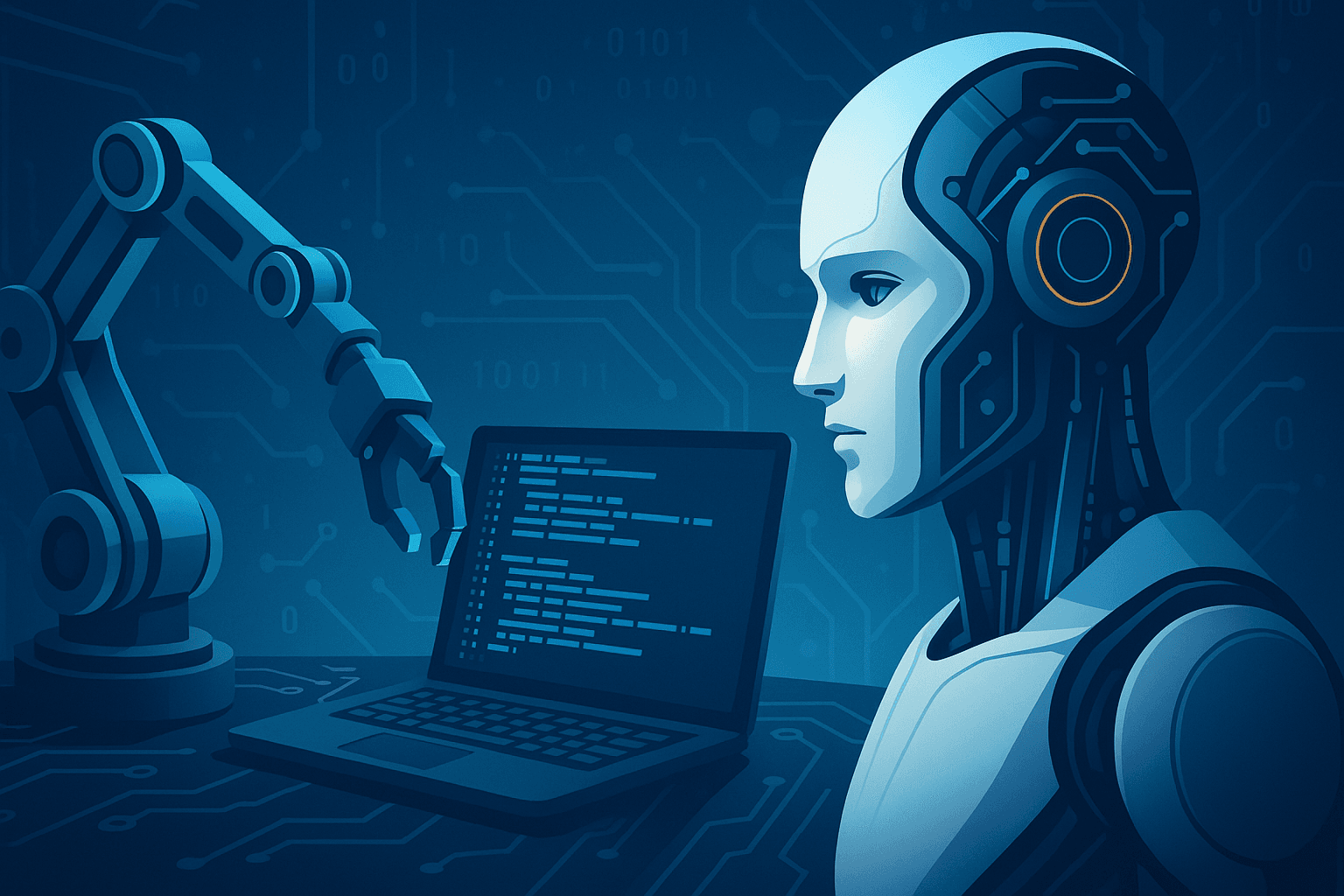
We're seeing the same transformation now in software development, powered by AI, more specifically generative AI tools for software development.
From Builders to Architects and Supervisors
For sixty years, writing software has itself been a craft. Developers have built applications line by line, translating business requirements into working code. Every function, every form, every test had to be written by hand. Code generators were only suitable for simple use cases of very similar code patterns.
AI has changed that very quickly.
Tools like Claude Code, GitHub Copilot, Cursor, and dozens of task-specific agents can now generate boilerplate code, suggest functions, write tests, fix bugs, and even scaffold entire applications. What used to take days now takes hours, or even minutes. Developers are no longer typing everything from scratch. They're guiding, reviewing, and assembling. This shift mirrors the CNC transition from manual execution to digital orchestration. Just like machinists became CAD designers and system programmers, developers are evolving into:
- UI/UX designers who define the experience and intent of the software.
- Solution architects who design scalable systems and manage complexity.
- AI supervisors who prompt, refine, and verify outputs from code-generating agents.
- Ops engineers who monitor and manage software with AI-driven observability tools.
Software is still being built, but hands-on coding is no longer (or should no longer be) the bottleneck.
A Much Faster Revolution
Here's the big difference relative to the CNC revolution: speed. The transition to CNC took decades. Standards had to mature. Factories had to be retooled. Workforces had to be retrained. Companies had time to adapt.
The shift to AI-assisted software development is moving far faster. In just a few years, AI tools have gone from novel prototypes to everyday workflow. They're cloud-based, easy to use, and constantly improving. And because software is digital by nature, AI adoption in development doesn't face the physical constraints manufacturing did. The productivity gains can be immediate, and quickly compounding. This rapid tool shift is creating a labor model shift, just as rapidly.
What Happens to Technology Services?
The implications of this shift are just now dawning on many organizations. Many business and IT leaders are starting to ask the same question: What does this mean for our development teams? For our technology partners?
Here's the answer:
- Team composition is changing. You need fewer hands writing boilerplate and more minds designing systems, supervising AI outputs, and ensuring quality.
- The old staffing pyramid is breaking down. Relying on a wide base of junior developers is less efficient when AI can do much of the routine work. Value moves upstream to specification, architecture, and orchestration.
- Partner selection will evolve. The best firms won't be the ones offering the largest teams. Instead, they'll be the ones offering the most human CPU power: strong architects, disciplined design teams, and experience managing AI-augmented workflows.
From Code to Control
AI isn't replacing developers. It's replacing certain tasks within the development process, particularly those related to coding and project management. Especially those that are repetitive, rules-based, or well-structured. The human role is shifting from builder to supervisor, from execution to design.
This change is happening now. Not in 10 years. Not after another round of innovation. Already, teams using AI effectively are building and shipping faster, responding to change more fluidly, and building systems with fewer errors and less cost.
If CNC reshaped manufacturing over a generation, AI is reshaping software in real time.
The companies that will thrive in this new environment won't be the ones with the most developers. They'll be the ones with the best control systems: the clearest designs, the most adaptive teams, and the sharpest sense of how to turn intent into software—at speed, with AI in the loop.