
Contents9 sections
A new kind of restructuring: layoffs with an AI footnote
A software developer opens her laptop to find a new internal mandate: use the company's AI coding assistant on every task. The tool shows flashes of promise, but it also fabricates functions that do not exist and tangles dependencies her team must later unwind. Reporting from inside one of the world's largest tech firms documented how the internal assistant, called Kiro, has at times hallucinated and slowed work even as leadership pushed to expand its use, according to The Guardian.
Across the industry, similarly framed announcements have arrived in waves. Oracle is planning thousands of job cuts while managing a cash crunch tied to a massive AI data center expansion, an investment choice under capital pressure rather than a retreat, according to independent financial reporting by Bloomberg. Atlassian disclosed in state filings and an executive memo that it cut roughly 1,600 jobs globally, including 252 in San Francisco, to self-fund deeper investment in AI and enterprise sales, with leadership noting that AI is changing the mix of skills the company needs, as reported by the San Francisco Chronicle. Fortune reported that Microsoft announced about 9,000 reductions, just under 4 percent of its workforce, alongside a high-profile shift toward AI-driven products and services.
Aggregators like Layoffs.fyi have tallied sector-wide reductions across hundreds of firms, a running view of scale that business media often cite in real time. Motives and mechanics differ by company and are best understood through filings and credible reporting, but a common signal runs through the noise: many big tech players are trimming in one area to fund larger AI bets in another.

This is not a moment to hesitate; it is a moment to move forward with eyes open. The right takeaway for leaders outside big tech is to act on AI now, but to make momentum measurable and governance real.
Big iron, rented intelligence: what costs really matter for most organizations
The economics of AI explain why the biggest firms are reshaping budgets. In Oracle's case, reporting tied planned job cuts to a cash crunch from a large-scale AI data center expansion, the kind of fixed investment that hyperscalers and major platform providers make to secure capacity. Follow-on Bloomberg analysis portrayed a significant restructuring with associated costs, consistent with leadership prioritizing AI infrastructure as a strategic asset worth near-term pain. Microsoft's reductions arrived with an explicit strategic tilt toward AI-driven products and services, sharpening competitive pressure for the rest of the industry.

That fixed-infrastructure story is real in big tech. For most other organizations, however, the economics look different. Rather than building data centers or training frontier models, they will consume AI through cloud platforms and APIs, and their costs will concentrate in places they can directly manage: preparing data, integrating AI into live workflows, securing and governing its use, and helping people adopt it. Practitioner guidance underscores this distinction. Halyard Consulting, an advisory firm that counsels organizations on AI delivery, emphasizes that scope and complexity drive cost and timeline primarily through data preparation, integration, and ongoing model maintenance, not capital construction. Tonic3, a digital and AI services company, adds from an operator's vantage point that usage intensity, data scale, and refresh frequency shape ongoing expenses; operating costs often grow with adoption rather than ending at launch. These commercially published viewpoints should be read as practitioner advice, not official statistics, but they align with independent reporting that the most visible fixed costs sit with hyperscalers, while most enterprises face variable, consumption-based costs and integration work.
The implication is practical and immediate. Leaders outside Silicon Valley do not need to underwrite new data centers to move on AI. They need to prove, quickly and credibly, where rented intelligence improves outcomes in the workflows they already run.
What this wave means for everyone else: move now, but make results legible
For banks, hospitals, manufacturers, and public agencies, the lesson of big tech's reshuffling is not to match its scale. It is to direct attention where it pays off fastest: problems you control, data you already hold, and teams whose work you can change. Independent practitioner syntheses reach the same conclusion. Enterprise value from generative AI shows up when organizations build the right data foundation, reimagine the target processes, and align the tech stack and governance with how people actually serve customers and citizens, a theme documented in Forbes' analysis of lessons from pilot programs. Reporting from inside a leading tech company offers a cautionary complement: rolling out immature tools without the right guardrails can add work before it removes it, delaying return on investment until reliability and process design catch up, as The Guardian documented.
The upshot is to act decisively, but make the numbers tell you whether to go faster. Choose a narrow, consequential use case where AI can plausibly create lift within a quarter. Test it in conditions that mirror production, with the people who will use it. Decide to scale or stop based on the business metric that matters, not on the wow factor of a demo, a discipline captured in independent guidance and reinforced by Agility at Scale, a consultancy that coaches organizations through AI programs.
Move forward, and make momentum measurable. Waiting is a decision to let someone else's learning curve compound instead of yours.
A practical pilot framework: test fast, prove value, then scale
Pilots let leaders buy information before they buy scale. The most effective ones compress learning into a short, bounded window and end with a decision. The distinction begins with scope. As Agility at Scale, a consultancy that coaches organizations through AI programs, puts it, a proof of concept answers whether something can work in a lab, while a pilot asks whether it does work here, with real users and constraints that mirror production. A credible pilot defines one business outcome up front, establishes a baseline for that metric, and sets explicit thresholds for success and failure. It also states the model performance required to move the business metric in the right direction, including confidence thresholds and error tolerances, so the team recognizes acceptable performance before code is written, a point stressed by Agility at Scale and corroborated by independent practitioner analysis.
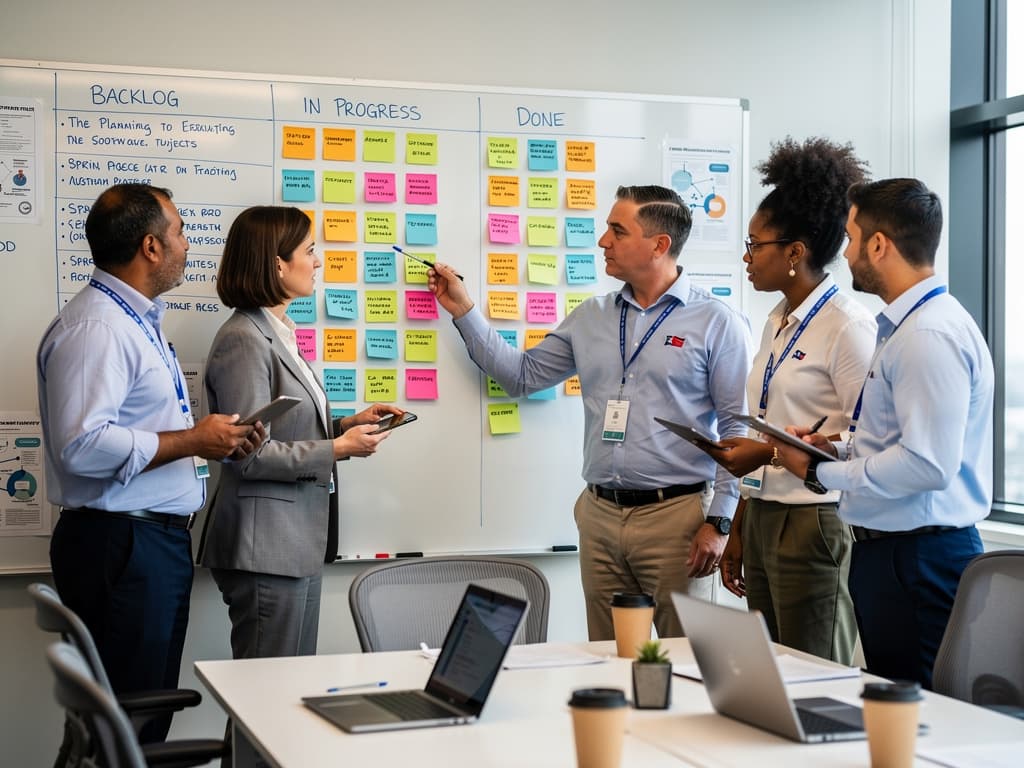
Decision quality improves when finance and product see the same numbers. High Peak Software, a software consultancy, proposes a 90-day pilot scorecard that tracks the change in the core KPI, translates it into dollar impact, and tallies total costs to create a board-ready view of ROI and risk on one page. The exact template matters less than the discipline: one place that shows the metric that matters, the money required to achieve it, and the assumptions and risks that still need vetting.
Governance belongs in the design, not bolted on at the end. The U.S. National Institute of Standards and Technology's AI Risk Management Framework offers pragmatic guidance for mapping risks, measuring impacts, and managing safeguards across the AI lifecycle; its spirit is to embed evaluation, oversight, and documentation from the first experiment. In a pilot, that translates to human review where errors could cause harm, access limits around who sees AI-generated outputs, robust logging for audit, and pre-agreed triggers for pausing or rolling back if the system's behavior falls outside tolerances.
For service workflows, success can be defined as a measurable reduction in average handle time with stable or higher customer satisfaction, model precision and recall clearing preset thresholds on a held-out sample, and a cost per resolved case that declines as usage increases. For internal knowledge or coding assistants, success can be defined as faster time to a first draft with a rework rate below an agreed ceiling, and no material uptick in operational incidents attributable to the tool. If, after a fixed window, the KPI lift falls short and error rates exceed tolerances, the pilot should pause, capture learnings, and be redesigned before any scale-up, with the decision recorded in the one-page scorecard approach from High Peak Software.
A disciplined pilot is the fastest way to prove value and the cheapest way to fail. Leaders who insist on baselines, user testing in realistic conditions, and finance-grade accounting of benefits and costs will know whether they are buying acceleration or theater.
Numbers that matter: budgets, timelines, and who you need on the team
The fastest path to real signal is to time-box and right-size the work. A 90-day cadence, popularized by operator playbooks like the scorecard from High Peak Software, a software consultancy, aligns with fiscal quarters and keeps cross-functional teams focused on tangible outcomes rather than sprawling roadmaps. Week zero sets scope, baselines, and governance. Early weeks prepare data and stitch the model into the live workflow for a small user cohort. The middle weeks run the pilot and iterate. The final weeks lock measurements, count costs, and decide whether to scale or stop.
Staffing mirrors the scope. Credible pilots are typically led by a product owner with authority to set scope and accept outcomes, supported by a data engineer to source and prepare data, a machine learning practitioner to configure and evaluate models, and someone with MLOps or DevOps skills to manage deployment and observability in a safe environment. Crucially, they embed domain experts or power users from the target process, because they define realism, surface edge cases, and ultimately judge whether the AI helps. Those team choices echo independent practitioner guidance that change management and process redesign move alongside technology when pilots succeed.
Budgeting is less about guessing a number and more about funding the activities that create decision quality. Halyard Consulting, an advisory firm, emphasizes that scope and complexity drive both cost and schedule because they govern how much data cleaning, integration, and model iteration will be necessary. Tonic3, a digital and AI services company, reaches a complementary conclusion from an operator's vantage point: ongoing costs pivot with usage intensity, data scale, and refresh frequency, so leaders should expect run costs to evolve with adoption rather than remain static after launch. Those commercially published viewpoints should be read as practitioner advice, but they align with independent reporting that the fixed and variable costs of AI programs are meaningful and recurring for firms that choose to scale. The budgeting upshot is simple and actionable: fund the minimum viable, cross-functional team you need for one quarter to answer one question, and track the KPI delta and fully loaded costs on a single page, in line with the approach from High Peak Software.
Mind the risks: governance, vendor lock-in, and operational pitfalls
Moving quickly does not mean moving recklessly. First-person reporting from inside a leading tech company shows how internal AI tools that hallucinate or produce low-quality outputs can increase rework, slow teams, and erode trust, especially when expectations get ahead of reliability, as The Guardian documented. The lesson is operational as much as technical: keep humans in the loop where the cost of error is high, expand scope gradually as accuracy improves, and set a culture that treats early AI outputs as drafts to be verified, not oracles to be obeyed.
Governance accelerates, rather than slows, responsible speed. NIST's AI Risk Management Framework lays out a pragmatic discipline for identifying the risks tied to a particular application, measuring their likelihood and impact, and managing them with safeguards across the AI lifecycle, from data collection to deployment and monitoring. In practice, that means instrumenting pilots with audit logging and traceability, conducting bias and robustness checks where models influence decisions that affect people, and creating escalation paths when outputs fall outside approved bounds. It also means thinking ahead about vendor and model lock-in. While there is no single correct answer on build versus buy, a pilot should test not only whether an AI capability works but also whether the organization can swap vendors, models, or deployment patterns without rewriting the entire stack. NIST's emphasis on supply chain and lifecycle risk provides a useful scaffold for that analysis.

Finally, the social side of risk deserves explicit attention. If a pilot will change how a front-line team does its work, involve them early and be transparent that the experiment aims to improve outcomes, not to grade individuals. When users see their feedback changing the system and their oversight catching real errors, adoption rises. When they are told to trust a tool because leadership has decided, adoption falls. Credibility is earned in production, one resolved task at a time.
Two short stories: a pilot that paid and a pilot that pivoted
Consider a mid-sized insurer with overburdened customer support. The team chose a narrow use case: triaging inbound emails into categories and routing them to the right specialists. Before touching a model, they measured the current state of play, including average handle time, backlog aging, and customer satisfaction at resolution. They then stood up a pilot with a small cohort of experienced agents in a safe environment that mirrored production. The AI classified and summarized each message, proposed a priority, and suggested routing, but agents retained full control. After two weeks of calibration, the team ran the pilot for two more months. Average handle time for simple cases dropped by double digits. Backlog for low-complexity work shrank. Satisfaction nudged up as customers received faster first responses with clear expectations. The model's classification accuracy, measured against a holdout set and spot-checked in production, cleared the threshold set at the outset. Finance and product reviewed a one-pager translating the KPI delta into dollar impact and tallying fully loaded pilot costs in people and cloud. The team scaled gradually, expanding to additional queues while rolling out agent training and better monitoring. The arc reflects independent practitioner lessons that data foundation, process redesign, and governance move together when pilots succeed, and mirrors the one-page, 90-day scorecard discipline advocated by High Peak Software.

Now consider a different organization's internal coding assistant. Engineers were encouraged to use it broadly, but the tool often hallucinated APIs and produced fragile code that broke in integration. Senior leaders were clear about the goal, faster delivery, but less precise about where and how the assistant should be used. Developers spent valuable time fixing low-quality suggestions or reverting them entirely. The pilot lacked a crisp scope, did not set baselines for engineering metrics like rework rate and defect density, and launched without enough guardrails. Anecdotes mounted faster than measurements. After two months, engineering leadership paused the rollout and refocused on two tasks, unit test generation and boilerplate creation in well-understood services, where both speed and error rates could be measured cleanly. The pivot echoes lessons reported from inside a tech giant: AI can add friction when thrown at everything and create value when applied precisely, with oversight.

Good pilots don't just reduce risk; they create the conditions for scale. They answer one question decisively and make the next investment obvious.
A simple ask for leaders: act now, measure hard, govern early
The connection between layoffs and AI funding is real, but the lesson is not to cut your way into a future you have not tested. Reporting on Oracle's restructuring highlights how the fixed costs of AI infrastructure can drive near-term tradeoffs for hyperscalers and platform providers. For most organizations, the path is different and more accessible: rent capability, integrate it where it matters, and prove it in your numbers before you scale it. NIST's framework reminds leaders to embed risk management from the first experiment. And the 90-day scorecard proposed by High Peak Software exists so boards and executives can see, on a single page, whether promised benefits are materializing before they underwrite another quarter of spend.
The charge is clear. Pick one use case that matters. Define what better means in business terms. Build just enough to test it in the real world, with real users, for a fixed window. Track the metric and the money with the same numbers. Apply governance from day one. Then scale what works and stop what does not. That is how to move confidently into AI: fast enough to seize advantage, and disciplined enough to sustain it.
Sources
- Bloomberg. 2026-03-05. Oracle Layoffs to Impact Thousands in AI Cash Crunch.
- San Francisco Chronicle. 2026-03-17. Software giant cuts more than 250 San Francisco jobs in pivot to AI.
- Fortune. 2025-07-02. Microsoft lays off 9,000 in AI drive, bringing total job cuts to 15,000 this year.
- The Guardian. 2026-03-11. Amazon is determined to use AI for everything — even when it slows down work.
- Layoffs.fyi. 2026 Tech Layoffs Tracker.
- Bloomberg. 2025-09-24. Oracle's AI-Fueled Cash Crunch Sets Stage for Major Job Cuts.
- Forbes. 2024-07-15. From Pilot to Production in Generative AI: 3 Lessons Learned.
- Agility at Scale. AI Proof of Concept (PoC) and Pilot Projects: How to Validate and Scale.
- Agility at Scale. Generative AI Pilot Metrics: How to Measure and Prove Enterprise AI.
- NIST. AI Risk Management Framework.
- High Peak Software. The 90-Day AI Pilot Scorecard: From KPI Delta to Board-Ready ROI.
- Halyard Consulting. 2025-02-04. AI Project Costs and Timelines: A Strategic Business Guide.
- Tonic3. The Truth About AI Budgets: Building, Running, and Staffing for Results.
- Forbes. 2025-05-13. Microsoft Lays Off 3 percent as It Shifts Focus to AI Growth.
- Morning Brew (X). The tech layoff tally so far in 2026.